Regulatory Status of DTE’s East Petoskey Pipeline Reinforcement Project
DTE is actively pursuing property rights from owners for the East Petoskey Pipeline Reinforcement Project. This post explains big picture issues implicated by the project. The location of the project is included in this map.
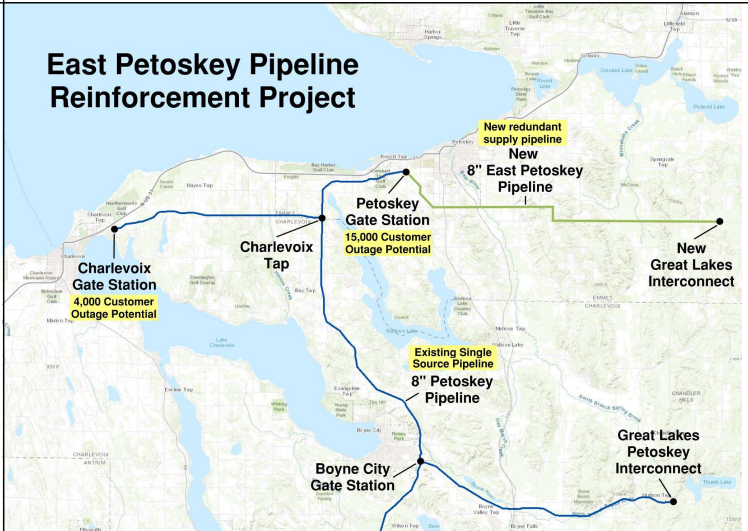
While DTE has referenced its Petoskey pipeline project as part of proceedings in the Michigan Public Service Commission, it is not seeking a certificate that avoids review by the circuit court. However, the proceedings provide insight into what DTE proposes, including two potential challenges to DTE’s taking.
Michigan eminent domain statutes identify the standards governing circuit review. “[W]ith respect to an acquisition by a private agency, the court at the hearing shall determine the public necessity of the acquisition of the particular parcel. The granting of a…certificate by the public service commission… constitutes a prima facie case that the project in furtherance of which the particular parcel would be acquired is required by the public convenience and necessity.” MCL 213.56(3). As such, acquisition of a certificate from the Michigan Public Service Commission requires deference from the circuit court as to certain issues.
Presumably, MCL 213.56(3) contemplates deference to the MPSC because impacted property owners are entitled to service and the opportunity to oppose either the project or the acquisition of their property at that time. Unlike public agencies like municipalities, counties, and the state, private agencies are driven by their profit motive and not responsible to the state’s voters. If the MPSC does not provide oversight, the circuit court should.
DTE has referenced its Petoskey pipeline project as part of U-21973. However, this proceeding is a rate case, not a certificate case. That means that DTE has requested the opportunity to raise its electrical rates. As part of that process, DTE has identified budgetary issues, including capital projects that it desires to undertake. DTE’s Petoskey pipeline is one of those projects. Yet, the focus is budgetary and not whether the project is an appropriate reason to use the power of eminent domain. The circuit court will retain the power to evaluate whether eminent domain is appropriate, as it should since DTE did not notify impacted property owners of the MPSC case.
Even though it does not seek a certificate, reviewing case U-21973 is informative for impacted property owners. For example, DTE’s testimony provides information about what it intends to do: “The East Petoskey Pipeline Reinforcement project involves construction of a new, 13.5-mile 8” diameter distribution pipeline from a new East Petoskey Interconnect Station at Great Lakes Transmission to Petoskey Gate Station, along with new remotely controlled valves at the Petoskey Gate Station, Charlevoix Tap, and Boyne City Gate Station.” The same testimony also described the project as part of DTE’s “natural gas infrastructure.”
Condemning agencies are limited to acquiring only those property rights required for the project necessitating the taking. In Troy v Barnard, 183 Mich App 565 (1990), while the City was allowed to acquire property rights to build a sidewalk, its case was dismissed for lack of necessity because it sought excessive rights. “Clearly, neither seventeen feet nor twenty-seven feet are necessary for the construction of a five-foot sidewalk. We believe that the words ‘public necessity’ and ‘necessity’ in the UCPA mean a necessity now existing or which will exist in the near future, not an indefinite, remote or speculative future necessity….Plaintiff's acquisition of excess property, premised on the hope that it might widen Square Lake Road sometime within the next thirty years, does not meet the test of necessity. Further, the fact that plaintiff can utilize this extra land in the meantime for other purposes, such as utility placement and snow storage, does not help to justify the condemnation.”
As such, DTE should be limited to seeking only those property rights required to construct a single 8” diameter natural gas pipeline.
However, the easements currently sought by DTE could be considered excessive. DTE requests that property owners convey the right to construct unlimited numbers of pipelines of unrestricted size to transport anything capable of moving through a pipe and allows DTE to partially assign its rights to other pipeline companies.
This provides a powerful incentive for property owners to refuse to grant the voluntary easements that DTE seeks to acquire. It is questionable whether DTE is willing to face a court challenge to the breadth of its easements as opposed to accepting conveyances from property owners who may not understand their legal rights.
Case 21973 also could provide a road map to oppose the project as a whole and not just seek to limit the property rights sought by DTE. The City of Ann Arbor intervened in the project and offered expert testimony from an engineer questioning the need for the project. Rick Brown, an independent engineering consultant specializing in gas system design, operation, and analysis testified that the, “expense of the new, redundant East Petoskey Pipeline is not justified by either the remote risk that backup gas will be needed during the ILI on the existing Petoskey Pipeline or as a mitigation strategy for potential future failure of the existing pipeline. As discussed above, other viable, much lower-cost alternatives exist to mitigate the risks raised by the Company. In my experience, these alternatives are regularly used by gas utilities to mitigate the risk of pipeline failure.”
The potential to challenge the project as a whole should disincentivize DTE from seeking excessive property rights. MCL 213.66 allows property owners to recover the hourly attorney fees that they incur as part of a successful challenge to the taking. It would be imprudent for DTE to allow owners to combine two challenges, particularly where the necessity challenge is very strong.
If you have been contacted by DTE regarding this matter and would like to discuss your legal options, please feel free to contact me.
This publication is intended for general informational purposes only and does not constitute legal advice or a solicitation to provide legal services. The information in this publication is not intended to create, and receipt of it does not constitute, a lawyer-client relationship. Readers should not act upon this information without seeking professional legal counsel. The views and opinions expressed herein represent those of the individual author(s) only and are not necessarily the views of Clark Hill PLC or Clark Hill Solicitors LLP. Although we attempt to ensure that postings on our website are complete, accurate, and up to date, we assume no responsibility for their completeness, accuracy, or timeliness.